Short answer: Ingredients are listed from the highest amount to the lowest, so the first few tell you what the shampoo is mostly made of: water and the cleansing agents. Look at the cleanser type, whether it suits your scalp, then the conditioning ingredients. Words like natural, organic or dermatologist-tested on the front of the bottle do not tell you much without the ingredient list.
How is a shampoo ingredient list ordered?
In India and most markets, ingredients are listed in descending order of amount, usually with water (aqua) first. Ingredients at very low levels can be listed in any order. That means a plant extract named at the end of a long list is present in a small amount. This is not a flaw, since many active-looking ingredients work at low levels, but it helps you judge how much weight a front-label claim deserves.
What are the main parts of a shampoo?
| Part | What it does | Examples you may see |
|---|---|---|
| Water | Base of the formula | Aqua |
| Cleansers (surfactants) | Lift oil, dirt and product build-up | Sodium lauryl sulfate, sodium laureth sulfate, cocamidopropyl betaine, decyl glucoside |
| Conditioning agents | Reduce tangling and static | Cationic polymers, dimethicone, panthenol |
| Thickeners and stabilisers | Give body and keep the formula even | Cocamide DEA, salt, gums |
| Preservatives | Stop bacteria and mould growing | Phenoxyethanol, sodium benzoate |
| Fragrance and colour | Scent and look | Parfum, colour index numbers |
| Extracts, oils and vitamins | Add feel and marketing appeal | Argan oil, rosemary, tocopherol (vitamin E) |
Sulfate-free, paraben-free, silicone-free: what do they mean?
Sulfates are strong cleansers. They work well on oily scalps and heavy build-up, but some people with dry, sensitive or colour-treated hair find them too stripping. Our guide to sulfate-free shampoo in India explains who may prefer to avoid them. Parabens are preservatives; you can read why some people choose to avoid them in Why Use Paraben Free Shampoo. Silicones coat the hair for slip and shine and can build up on fine or oily hair; see Silicone-Free Conditioner: What It Is and Who Should Use One. None of these choices is right for everybody. They are preferences that depend on your scalp and hair type.
How do you match a label to your scalp?
- Oily scalp: a cleaner formula, rinsed well, and lighter conditioning on the lengths only.
- Dry or flaky scalp: a gentler cleanser; check whether the flaking is dryness or dandruff using our guide on dandruff vs dry scalp.
- Colour-treated or dry hair: mild cleansers and added conditioning ingredients.
- Sensitive skin: fewer ingredients, and patch test new products, especially if fragrance affects you.
Examples from the Karvannall range
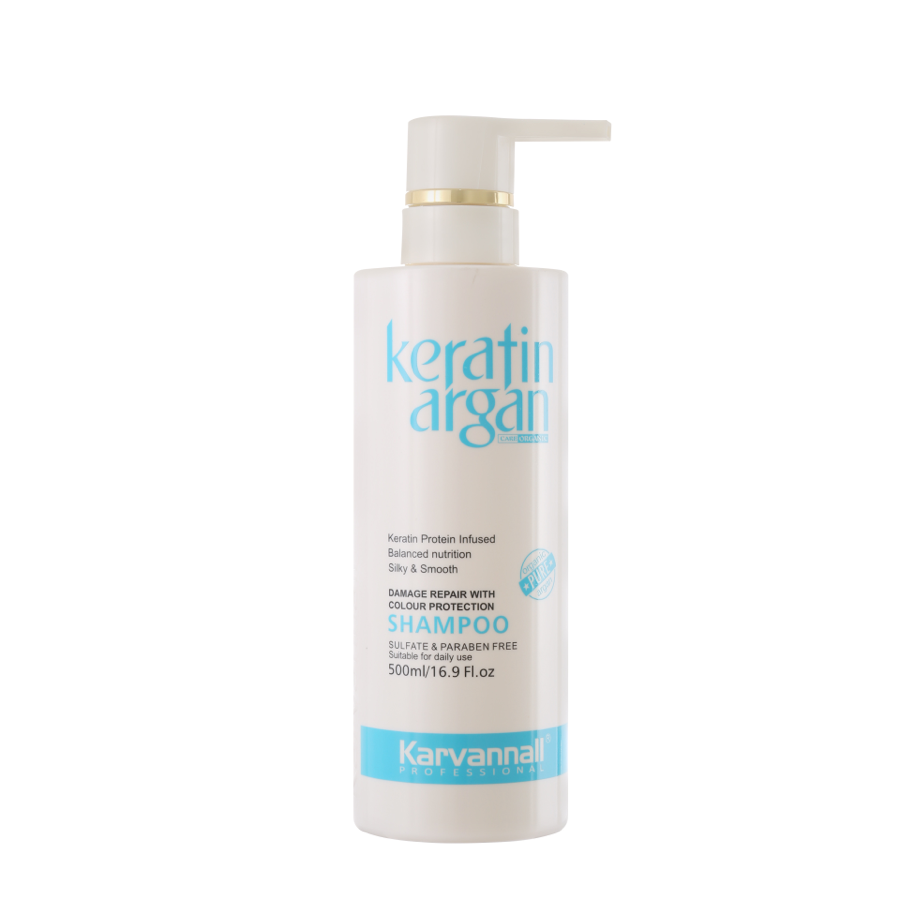
The Vitamin E Hair Shampoo product page describes a gentle cleanser with vitamin E, to be lathered on wet hair and rinsed. The Keratin & Argan Hair Shampoo lists keratin protein and argan extract and is described as dissolving impurities and build-up. The Silicone-Free Hair Conditioner is described for normal to oily hair. Always read the actual ingredient list on the pack you receive, since the full INCI list is what counts. Browse more in the shop.
Label claims to be careful with
- Natural or organic: not tightly defined on a shampoo bottle unless a recognised certification is shown.
- Clinically proven or dermatologist-tested: ask what was tested and on whom; there should be a named study or certificate.
- Repairs damage: hair is not living tissue, so products can improve feel and reduce breakage but cannot truly heal a damaged strand.
- Stops hair fall: a shampoo cannot treat the underlying cause of hair loss. Persistent hair loss needs a medical opinion.
A quick three-step label check
- Read the first five ingredients to understand the cleanser and base.
- Check for anything you know irritates you, such as a particular fragrance.
- Decide whether the front claims are supported by anything on the back.
Frequently asked questions
Does the order of ingredients on a shampoo matter?
Yes. Ingredients are normally listed from the highest amount to the lowest, so the first few show what the shampoo is mostly made of. Ingredients at very low levels can be listed in any order.
Are sulfates bad for hair?
Not for everyone. Sulfates clean well and suit oily scalps, but some people with dry, sensitive or colour-treated hair prefer gentler cleansers.
What does INCI mean on a label?
INCI stands for International Nomenclature of Cosmetic Ingredients, a standard naming system for ingredients so the same ingredient has the same name across brands.
Is a longer ingredient list worse?
Not necessarily. Many ingredients are cleansers, preservatives and stabilisers that a formula needs. What matters is whether the ingredients suit your scalp and hair.